

Is “Buyer Beware” the Best Money Advice Ever?

October 30, 2026
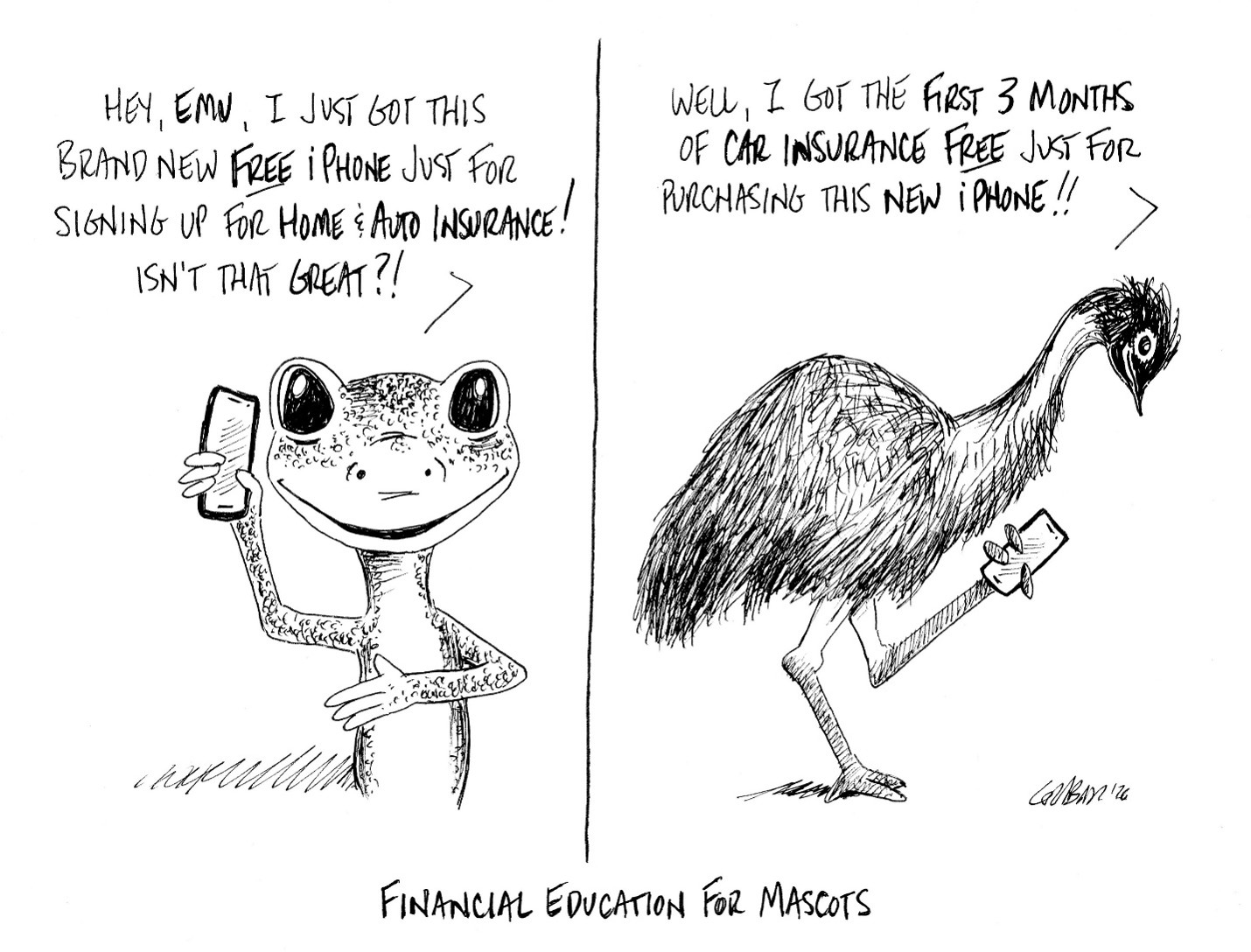
Alert #1: What follows might sound like whining and complaining. It’s really not, but I admit that I had trouble making these points without at least feeling a little grumpy. Maybe grumpy is ok when it comes to money conversations. No? Well, get off my lawn! After you read this post, of course.
“Buyer beware” sounds like something Ben Franklin could have penned while advising his fellow patriots on a land purchase that might have contained too many wetlands. The reality is that the phrase comes from Latin (caveat emptor), was probably first used in Roman times, and became part of English common law centuries ago.
I don’t know if there has ever been, in my lifetime anyway, a greater need for the buyer to beware than there is today. Let’s add this to the many reasons why financial education is a critical tool for navigating American capitalism. Despite agencies and laws and the best efforts of certain personal finance educators and coaches, the marketing machine adapts, squirms, shapeshifts, and takes license with words in order to separate us from our money. And that makes me, well, grumpy. It also motivates me to have these conversations.
Alert #2: What follows might feel a bit anti-capitalist. No, not at all. I’ve said it before and here it goes again: it’s not perfect but it’s the best “ism” we’ve got so far, and until there is something better, I’m a willing participant.
The free phone gimmick might be the champion of this infamous competition. There was a time when mobile phone carriers were giving away a “free” phone with new contracts, but those phones were the base models at the time, so it was at least somewhat believable that the company would be absorbing those losses in order to gain contracted customers. But in today’s market the free item in question tends to be a higher-end model with a retail value of $1000 or more.
As far as I know, all of the major carriers are for-profit corporations, usually public corporations, and their top responsibility is to maximize shareholder wealth – in other words, make a profit. Giving away $1000 or more to customers is not going to keep them in business very long. Indeed, the customer is paying for the phone. The trick is finding out where the bill is hiding and, just like with any purchase, determining whether it is worth it. It’s really just a form of financing the phone, spreading the cost over time through contracts, small but steady add-on fees, higher costs for the service, etc.
More Freedom with the Word “Free”
It’s Friday night. Maybe it’s raining. You’re hanging out at home, looking to watch a movie or sports event, and you see “Free (with subscription).” Yes, I fell for it once. Followed the trail of clicks for the free movie only to find that the subscription was $7.99 per month.
This one has quickly risen to the top of the deception charts as streaming and subscription services continue to dominate the entertainment consumption landscape. It has also provided plenty of laughs in my living room as my 14-year-old son has picked up on the absurd abuse of “free”. Now whenever he sees something for free he’ll often add, “Absolutely free…for just $5”.
This is where Mr. Grumpy grabs the keyboard. $7.99/month for a subscription is not necessarily a bad thing (although that is nearly $100/year, and how many of us only have one subscription? See the post on small stuff adding up to big dollars or FAME’s webinar about leaky budgets). The blood boiling issue, once again, is that we are drawn in by “free”.
Caveat emptor.
Dishonorable Mentions
I’d like to really get into it on so many more examples, but a blog has its limits. Here are a few more to scrutinize. Hold onto your wallet and walk away.
- Car insurance ads claiming that customization to save money is some sort of novel concept. Every company allows for choices in coverage, which in turn affects the cost of a policy. First rule of insurance is to have adequate and appropriate coverage, not the cheapest coverage.
- Rounding-up apps that claim to help you save or invest those pennies here and there by rounding up purchases, but some charge as much as $30,$40, or more per year! Yikes, how is that helping?
- Anything related to short cuts when it comes to investing. If someone has truly solved the math of the stock market, then why are they selling their secret for $39 on Facebook? Why haven’t they socked enough away from trading success to disappear on a faraway island? Right.
- The Most Dishonorable Award goes to … sports gambling groups who offer “free” bets or “risk free” bets. Ugh. No moral judgement on gambling from me, but I am judging anything that suggests that there is anything “free” about gambling.
This Blog Is Not Free
Have I ever mentioned that the best personal finance practices are rooted in economics? Everything has a cost. It might not be a cash cost, but there is a cost. The money management trick is to identify the cost and decide whether it’s acceptable for what you are receiving. This blog costs time. Time you could spend doing something else. Surfing streaming services, for example, compared to 10 minutes of reading. Deal or no deal?
I can’t fully equip anyone including myself, my 14-year-old, the students in my classes, or my blog readers, to defend themselves against the details of every misleading ad campaign loaded with “free” stuff. But I can offer some skill building tips which can help our approach to these situations: a defense in the fight for our cash.
- Habits over hacks. Not only do these borderline scams take our money, but they also keep us from paying attention to the only proven path to financial wellness – good money habits practiced over time.
- TANSTAAFL. There ain’t no such thing as a free lunch. Second best money advice ever after “Buyer Beware”?
- There is a fine line between misleading ads and scams, and where one exists the other might be lurking.
Companies want to make a profit. I want them to as well – I’m an investor! But when it comes to being an individual consumer trying to make the most of that money, again, buyer beware. Take part in our financial system, in our form of capitalism. Participate through education and financial education, banking, saving, investing, and spending less than you make. The alternative is that the system just takes from you.
About the Author:
Steve has worked on financial literacy efforts in Maine since 2004, and in July 2023 he started at FAME as a Financial Education Programs Specialist. He is an Accredited Financial Counselor (AFC®), a WISE-Certified Personal Finance Educator, has a B.S. in economics from Southern Connecticut State University, an MBA from the University of Hartford, and served as a U.S. Peace Corps Volunteer.
In the fall of 2003, he started a 20-year connection to the Waynflete School in Portland, where he taught math and personal finance, advised middle and upper school students, and coached baseball. Steve worked with students to create the Finance Club and an award-winning LifeSmarts team (Nationals 2013, 2014, and 2015). In 2011, Steve coached a Waynflete team to victory in the Boston Federal Reserve Economics Cup Challenge.
Steve was named Maine Jump$tart Financial Educator of the Year for 2012, was the keynote speaker at the Maine Jump$tart Annual Teacher Conferences in 2015 and 2023, and was Maine Jump$tart’s training coordinator from 2017 to 2023.
Steve and his family moved to Seville, Spain in July 2016 where he taught English and business English and learned many new personal finance lessons. He now lives in Portland with his wife and their son.
Legal Disclaimer:
EIN Presswire provides this news content "as is" without warranty of any kind. We do not accept any responsibility or liability for the accuracy, content, images, videos, licenses, completeness, legality, or reliability of the information contained in this article. If you have any complaints or copyright issues related to this article, kindly contact the author above.
